
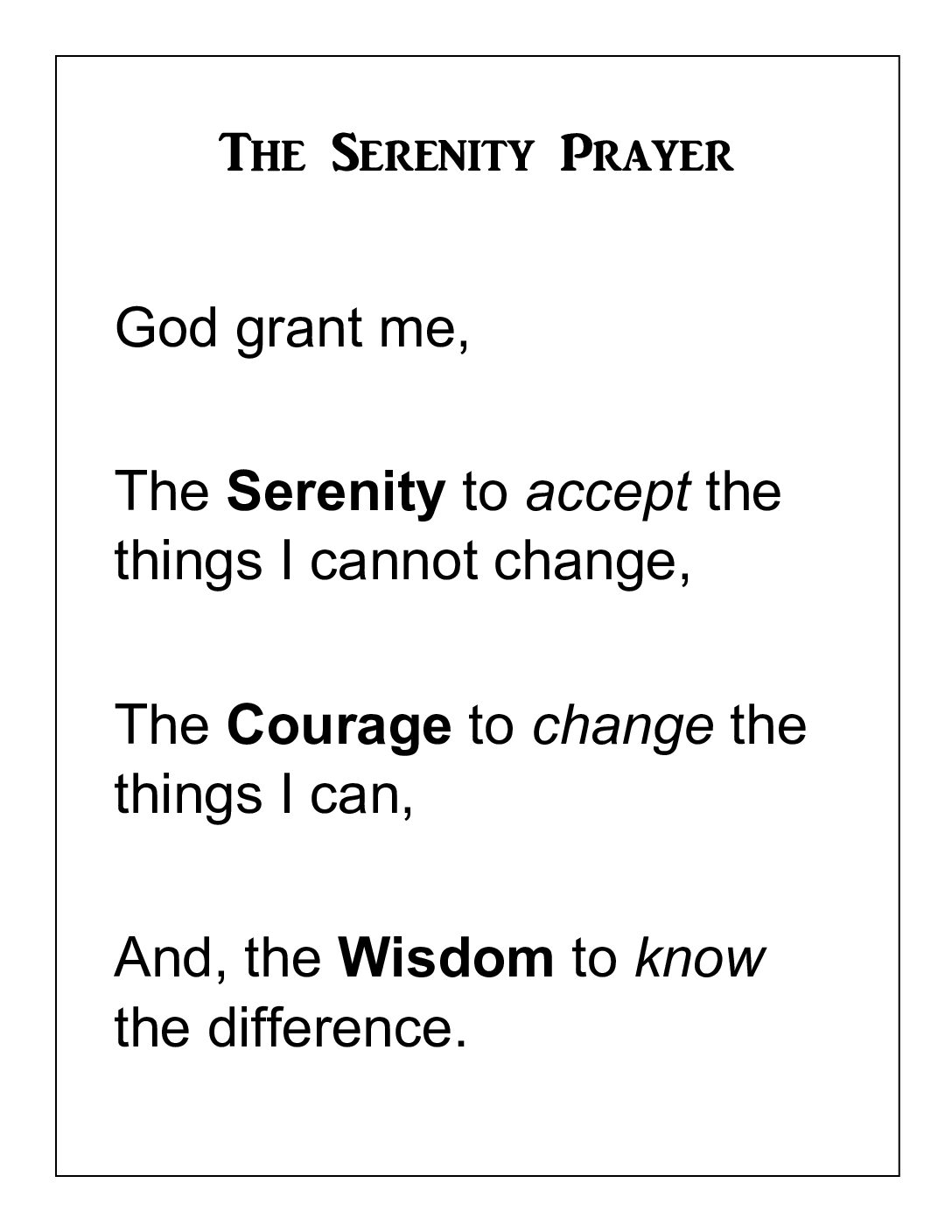
Back when I spent a lot of in local church-based twelve step programs, I became acquainted with this prayer known as the “Serenity Prayer.”
Whether you are a person of faith or not, I think you can appreciate the fact that life can essentially be divided into that which we can control and that which we cannot control.
When you get stuck, stressed out, or are in crisis, have you ever paid attention to your thinking?
Do you notice that you tend to focus on things outside your control? Perhaps you worry about a wayward spouse, a difficult boss, what your children are thinking, the economy, world events, or any one of a number of things that are beyond the scope of your control.
One of my favorite questions to ask when a client is focused on these things is:
Are you focusing on things within your control?
As you can imagine, generally the answer is a clear NO.
So, why is it that so many of us find ourselves worrying and wasting time and energy thinking about such things?
Other than the fact that we are human and flawed, I do think we can become entrenched in certain patterns of thinking that prove to be unhealthy and life-draining. Focusing on what we can’t control is one such example.
So what’s the antidote? Embracing acceptance.
Acceptance is about learning to acknowledge things as they are, as opposed to resistance, or the idea of getting worked up over the fact that things are not the way we’d like them to be.
Obviously, there are times when this is much harder to implement and may even be inappropriate to try to implement. Losing a loved one would be such an example. Being able to work through the stages of grief, including denial, anger, sadness, etc. is an important aspect of grieving. Yet even in these cases, a person will eventually have to come to a place of acceptance in order to move forward in a healthy way.
But you may still have some objections. You may be thinking, “Acceptance? Sean, are you kidding me? I hate what’s happening and I disagree with what’s happening!..how can you tell me to accept it?!?”
Great question! Acceptance of a person, place or situation in no way equates with approval, preference, or liking that person, place, or situation. I can be unhappy with a person, situation, or circumstance and still make the decision to accept the person, situation or circumtance as he/she, or it, is.
Why is this important?
It’s important because acceptance allows us to deal with reality rather than a false version of what is happening based upon our preference or denial of what is actually happening. Do you think it’s more effective to deal with reality through a distorted lens or a sober, realistic lens?
Think about it. When we accept things as they are, it opens the door to us seeing things more accurately and moving forward in a healthy way.
For example, if I have a problem with a bad habit or addiction, the sooner I accept this, the sooner I will start the process of moving towards healing and recovery.
Indeed, this is the very first step of the 12 steps, which says:
“We admitted we were powerless over [insert whatever unhealthy habit, unhealthy pattern of thinking, or addiction you are engaged in] and that our lives had become unmanageable.”
Key Takeaway:
Acceptance is an important principle to embrace for us to live life in a healthy way.
Questions for consideration:
Focusing on the first part of the serenity prayer, do you find that you tend to spend a lot of time focusing on things outside your control?
If so, where do you need to practice acceptance?
Do you know of people around you that seem to be able to accept life as it comes even when it’s difficult?
If you are a person of faith, do you need to ask God to help you have the serenity to accept things that you cannot change?
If these ideas seem challenging to implement in your life, consider setting up a complimentary discovery call with me, and let’s chat about what you need to move forward towards a thriving life!
